
Not Whether, But Where: What the Courthouse Study Means for Downtown Businesses
A new Springfield Regional Justice Center will get built, and it will generate economic activity for Springfield regardless of where it goes. That much is not in dispute.
What a new economic study argues is that location decides something else — where the daily activity of a working courthouse actually lands, and which businesses are close enough to benefit from it.
The assessment was prepared by Kimley-Horn, a national planning and economic development firm. It examines a single question: what happens to the downtown core if the courthouse moves north of the rail corridor?
The daily number. Between 1,200 and 1,500 people will pass through the building every weekday — judges, court staff, attorneys, jurors, litigants and members of the public. At 1,300 a day and $10 to $15 a head, that is $3 million to $5 million a year in coffee, lunch, parking and errands. Modest per person, substantial in aggregate, and repeated across roughly 250 working days a year.
It is an ecosystem, not a building. Kimley-Horn counted about 1,140 business locations in the Metro Center. Legal services is the largest single cluster — roughly 156 locations, nearly 14 percent of everything downtown, concentrated in the office buildings on and around Main Street within a ten-minute walk of the current courthouse. Attorneys locate near courthouses. Restaurants, print shops, parking operations and services locate near attorneys. Each leans on the others.
Downtown is not starting from strength. The study’s market review found apparent retail vacancy approaching 27 percent and office vacancy approaching 29 percent in the Metro Center, both well above regional figures. Of the 21,108 jobs downtown, roughly half sit in professional services and hospitality — the two sectors most exposed to any change in weekday foot traffic.
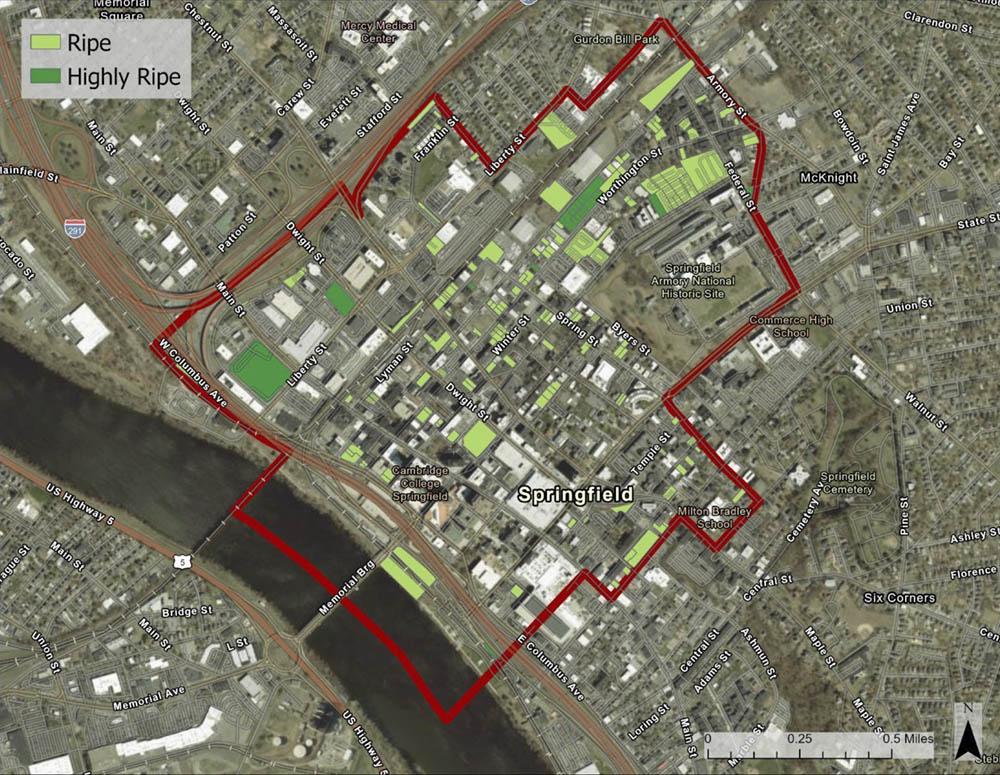
Proximity is the mechanism. A site north of the tracks would leave much of the core, including the Main Street legal cluster, more than a 15-minute walk away, with pedestrian access funneled through two rail underpasses built for cars rather than people. The point is not that people could not get downtown. It is that the trip stops being incidental — and incidental trips are what downtown retail runs on.
The risk is redistribution, not loss. This is the study’s central finding and it is worth stating precisely. Courthouse spending does not leave Springfield if the courthouse moves. It relocates within the city. The businesses currently capturing it are the ones that would stop.
Precedent is close by. Chicopee moved its District Court out of the Market Square area and has spent decades and considerable public money trying to rebuild that center. In Nevada City, California, a far smaller courthouse move was associated with an estimated 8.4 percent drop in downtown restaurant sales — roughly $1.8 million a year.
And it is a long commitment. A 40-year base lease, with options that could extend occupancy to 60 years. Whatever gets decided will outlast most of the businesses operating downtown today.